 JOIN THE VIP LIST











Low T3 usually means your body isn't converting well rather than that your thyroid isn't producing. Most T4 becomes active T3 outside the gland, in the liver, gut and other tissues, and that conversion runs on enzymes that need specific nutrients. Fix the cofactors and the chain works. Push more T4 into a broken chain and it doesn't.
If you've been told your thyroid is fine because your TSH is fine, and your Free T3 is sitting at the bottom of the range while you feel like you're moving through wet sand, this is the post I'd want you to read.
Why Low T3 Is Usually a Conversion Problem
Your thyroid mostly makes T4, which is storage hormone and does very little on its own. The deiodinase enzymes convert it to T3, which is the hormone your cells actually use, and the majority of that happens outside the thyroid gland.
That's why the conversion step is where things go wrong. A gland can be producing perfectly well while the chain downstream of it stalls, and a test that only looks at TSH will never show you that. It's also why raising T3 is usually a question of what the enzymes are short of rather than a question of making more hormone.
Which Supplements Increase T3?

Five B vitamins, each one named and dosed. That is what its own formula means in practice.
The nutrients with a genuine mechanical role in converting T4 to T3 are selenium, zinc, iron and the B vitamins. Selenium is the most direct of the four. The NIH's Office of Dietary Supplements states that selenoproteins play critical roles in the conversion of the prohormone T4 to the active T3, and that selenium concentration is higher in the thyroid gland than in any other organ in the body. No supplement raises T3 directly. They supply what the conversion needs.
Two cautions I'd rather say than leave out. More selenium is not better, and the same ODS fact sheet notes that most people in the United States already take in adequate amounts while 17% to 19% of adults take a supplement containing it. The American Thyroid Association specifically recommends against selenium supplementation in pregnant women with thyroid autoimmunity. Zinc and the B vitamins are the quieter two, and B vitamins have their own formula in B Fixxr rather than a token dose inside something else.
Iron is the fourth and the one most often low in women. Iron is stored as ferritin, losses are greater in menstruating women because of blood loss, and a woman whose ferritin has quietly drained will convert badly no matter what else she does. It's a blood test, it's cheap, and it's the one I'd want run first.
What Low T3 Feels Like
The symptoms of low T3 are the ones people get told are normal. Cold hands, a body that won't warm up, hair that thins at the ends, constipation, a flat mood, and a tiredness that sleep doesn't touch.
None of that is specific, which is the problem. Every one of those symptoms has half a dozen other explanations, and that's exactly why they get waved off in a seven minute appointment. What makes the picture coherent is the combination plus a Free T3 sitting at the floor of its range while everything else reads acceptable.
The Root Causes Worth Ruling Out
The root cause of low T3 is usually one of five things, and none of them is mysterious. Chronic stress comes first, because cortisol pushes conversion toward reverse T3. Undereating and hard dieting come second, because the body slows the chain down on purpose when calories drop.
Illness and inflammation do the same thing for the same reason. Low ferritin is the fourth. A gut that isn't absorbing what you're feeding it is the fifth.
Notice how many of those are things you did on purpose to feel better. Long stretches of low calories and hard training are the most common version I see, and the woman doing everything right is often the one whose conversion has been turned down as a protective measure.
That's worth knowing before you buy anything, because a nutrient can't override a signal your body is sending deliberately. If any of those apply, that's the thing to change, and the thyroid supplement guide covers what to layer on once it has.
Where T2 Fits

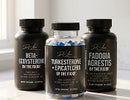
Thyroid Fixxr is the formula built around T2, and it belongs after the cofactor work rather than before it.
T2 is a step further along the same chain and it's a different conversation from the cofactors above. I've written what T2, T3 and T4 each do and the case for T2 in particular elsewhere rather than repeating it here.
The short version is that it's the active metabolic signal my thyroid formula is built around, and it belongs after the cofactor work rather than before it. Thyroid Fixxr is that formula, and it's where I'd point a woman whose cofactors are handled and who still wants the metabolic support.
What to Ask a Clinician If Your T3 Stays Low
If you've addressed the four cofactors and the root causes and your T3 is still at the floor, the next step isn't another bottle. Ask for Free T3 and Reverse T3 together rather than TSH alone, because the ratio between them is where a conversion problem shows up. Ask for ferritin with a number rather than a normal or abnormal. And ask what your clinician makes of a Free T3 at the bottom of a range while you feel the way you do.
Those are questions, not instructions. What happens next is a decision for the clinician monitoring you, and I'm not going to pretend a supplement page is the place it gets made.
FAQ
What to do if T3 is low?
Start by finding out whether it's a conversion problem, which it usually is. That means looking at Free T3 alongside Reverse T3 rather than at TSH alone, and checking the four cofactors the conversion runs on, which are selenium, zinc, iron and the B vitamins. Then look honestly at stress, calorie intake, illness and gut absorption. If all of that is handled and the number hasn't moved, it's a conversation with the clinician monitoring your thyroid.
What are the symptoms of low T3?
Cold hands and feet, a tiredness that sleep doesn't fix, thinning hair, dry skin, constipation, a flat or low mood, and weight that won't move on an honest effort. Every one of those has other explanations, which is why they get dismissed individually. It's the combination alongside a Free T3 at the bottom of its range that makes the picture worth taking seriously.
Which supplements increase T3?
None of them raise T3 directly. What they do is supply what the conversion enzymes need, and the four that matter are selenium, zinc, iron and the B vitamins. Selenium is the most direct, because the selenium-containing enzymes are the ones doing the conversion, and the thyroid holds more selenium per gram than any other organ. More is not better with any of them, and iron in particular should be checked with a ferritin test rather than guessed at.
What is the root cause of low T3?
Most often chronic stress, sustained undereating or hard dieting, illness and inflammation, low ferritin, or poor absorption from a gut that isn't working. Several of those are the body deliberately slowing metabolism down to conserve resources, which is why supplementing over the top of them rarely works. Finding which one applies to you matters more than any product decision that follows it.